
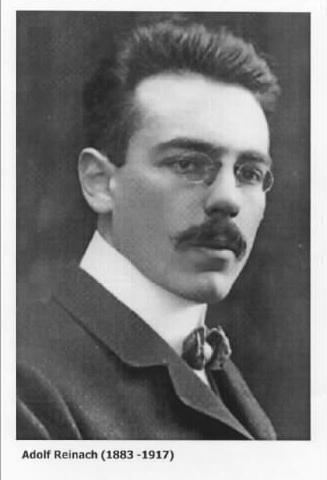
Adolf Reinach
Adolf Reinach (1883–1917) was a German philosopher and a pioneering figure of the phenomenological movement, closely associated with Edmund Husserl’s circle in Göttingen. A brilliant legal theorist, he developed a groundbreaking philosophy of law grounded in the theory of social acts — speech acts that create binding obligations between persons. His masterwork, The A Priori Foundations of Civil Law (1913), anticipated speech act theory by decades. Reinach converted to Christianity shortly before his death in World War I, leaving behind a body of work of remarkable depth for so short a life.
Adolf Reinach and the Idea of Law
Mônica Vasques Monteiro de Barros
Monicavasques37@gmail.com
Universidade Federal de Juiz de Fora

1. Introduction
This paper will present a study about the theory of apriori right and the relationship with positive law evidenced by Adolf Reinach. Being his philosophy recognized by the in-depth study of the philosophy of law and being always attentive to the social relations, he directed his look at the Law under the phenomenological bias, identified the legal life in the social interaction and defended the existence of legal entities independent of any interpretation, be pure. The work dealt with in this communication is analyzed according to the American translation and whose title already evidences its proposal, The Apriori Foundations of the Civil Law, therefore investigates the apriori right and the positive Law presenting the possibility of reasoning of the Law from a phenomenological attitude.

Adolf Reinach proposes that the foundations of right are realities. It emphasizes that besides the physical and the psychic, there is the distinct character of the ideal objects. The essential mark of these objects, such as numbers, concepts, propositions, would be their atemporality and universality. Being this right apriori condition for the elaboration of the positive law, which will prescribe the ought to be.

2. Apriori Right
The apriori right is a description of the being of right, independent of subjectivity and positive law, is timeless, pure, knowable only by reason and independent of all experience, is a condition of possibility of positive law. It states, therefore, that just as numbers exist independent of mathematical science and all human understanding, there are legal concepts independent of any positive law, existing apriori and self-evident.

From this thought comes the consensus that apriori statements are also valid for legal institutes. This apriori characteristic is intuitively evident, each circumstance is apprehended in the universal sense and necessary and described as concept as such. In Law there is a vast realm of a priori statements, which can consequently be formulated strictly and that are evident, allowing to be known by intuition, are independent of the conscience and of any and all legal order or legal institutes. He holds that such truths are not only necessary and universal, but examples of apriori synthetic truths. A truth, in view of this, as the foundation of knowledge and that is viable to be known and universalized, being the synthetic judgment a priori and it is exactly this judgment that must be based on human knowledge. Apriori knowledge is not only independent knowledge of all experience, but it is knowledge that has inseparable attributes, necessity and universality, so it will be rigorously universal and necessary.

In his book On Phenomenology, Adolf Reinach expounds with a clear clarity the apriori knowledge and his evidence by Plato:

It is true that the a priori has always been recognized, Plato discovered it and has not since disappeared from the horizon of the history of philosophy.

REINACH, 2014, p. 38
Through intellectual intuition apriori knowledge is brought to light, thus accessing the world of essences and their laws:

In the apriori, on the contrary, it is the vision of the essence and the knowledge of the essence. But to grasp the essence no sensible perception is required; In this case, these are intuitive acts of a very different nature, which can be carried out at all times, including wherever the representative subject is.

REINACH, 2014, p. 39
Apriori connections exist, regardless of whether all, many or no man at all or other subjects recognize them. They are universally valid at the most in the sense that everyone who wants to judge righteously must recognize them but this is proper not only of the apriori truths, but of all truth in general.

REINACH, 2014, pp. 40-41
Thus, Adolf Reinach, turns to the same things and seeks from the experience of the legal institutes to intuit and later describe its essence. The Reinachian apriori theory of Right is a way of manifesting the objectivity of the elements of the positive law. This law is descriptive, it intends to demonstrate the being of the Law, it refers not only to the individuality of the thing, to what distinguishes it from others, but all its eidetic content. This apriori as a science of connections apriori, an eidetic that is articulated in the axis of the relations between entities of different species.

One of the examples of aprioristic connections analyzed by Adolf Reinach is that which occurs between obligation and pretense produced by the promise. It focused on legal institutes, such as promise, property and representation, demonstrating that these institutes have apriori state of affairs. For Adolf Reinach, there are apriori material structures in all realms of reality.

2.1 Promise
Adolf Reinach begins his investigation by analyzing the promise. Its purpose was not to formulate a theory of the promise, but to show that the promise as other objects have universal and necessary relations, apriori. The promise as such creates pretensions and obligations, and this is a necessary relationship. When a person makes a promise to another happens an interesting effect, this promise produces a connection between the people involved, different from a simple information or to make a request. It creates an obligation on the side of those who have promised and an expectation for the other side, who will be satisfied with the fulfillment of the same, or for its revocation or renunciation. It is a necessary state of affairs, the relationship promise, obligation and pretension is essential to understanding any promise, including legal promise.

The laws governing the relationship between promising and promissory are immediately intelligible and valid. For example, a promise to do something dissolves as soon as the thing is done. It is noteworthy to point out that if such a promise is not fulfilled, the commitment of the promise still exists and with it the demonstration of the apriori, something previous to the human experience.

The strength of the binding effect that emerges in the promise, which is the pretension and the obligation, is underlined by Adolf Reinach:

Claims and obligations, by contrast, arise, last a definite length of time and then disappear again. Thus they seem to be temporal objects of a special kind of which one has not yet taken notice.

REINACH, 1983, p. 9
It is necessary to have a phenomenally unified experience, the understanding of the institute of the promise presupposes the understanding of the relation between obligation and pretension. However, pretension and obligation are independent legal institutes, but that in the promise are necessarily united. Thus, any individual who makes a promise is bound to the recipient of the promise. This relationship is the essence of promise, the being of promise.

The family, political, religious and legal promise are intelligible thanks to the underlying essence of promise they share, an a priori that makes them promise and understandable as such.

2.2 Property
When it comes to the concept of property, it addresses only the original property, the first property. His concern is to explain how the relation of property originates, or what makes one owner something to be recognized by others. It describes this apriori concept of property and affirms that the bond between a person and what he possesses is a particularly close and powerful union:

The relation between person and thing which is called owning or property is an ultimate, irreducible relation which cannot be resolved into further elements. It can come into being even where there is no positive law.

REINACH, 1983, p. 55
It is possible to observe that there are several types of relations of a person with a thing, but one is especially of great relevance to understand the original property, the relation of physical power. The person who has power over a thing, can use it, transform it, destroy it: "When Robinson Crusoe produces for himself all kinds of things on his island, these things belong to him." (REINACH, 1983, p. 55)

2.3 Representation
The representation exposes that acts can be performed "or in the name of" another person and so it is necessary to elucidate that who promises in this way is not promising for himself, but in performing the act he accomplishes the will of a third person. Adolf Reinach views this institute as a social act, going beyond any instituted law:

This is surely not just a modification of the linguistic expression but a descriptive trait of the performance of the act. It is in the "institution" of the positive law but rather the modification of social acts, which goes far beyond the world of right.

REINACH, 1983, p. 83
Analyzing the experiences that can be realized "on behalf of or for others," he notes that it is intrinsic to the representation that representative acts to be performed on behalf of others are not necessarily in accordance with the intention of those who perform them:

We can begin by asking which inner experiences underlie the social acts which are performed in the name of others. Here it is important to stress the negative point at the outset: it is indeed intrinsic to representative acts to be performed in the name of the others, but not necessarily according to their intention.

REINACH, 1983, p. 83
3. Positive Law
After my brief exposition on apriori right and following Adolf Reinach, a new challenge, the task of collectivity, appears to demarcate and protect each individual in his sphere of domination over things and events, as well as to emphasize the importance of organizing the law not only for a peaceful coexistence as for the defense of the freedom of individuals and the manifestation of their wills. Positive law arises therefore, with the mission of providing for the existence or possibility of what is allowed. It assumes a general function that grants legal protection, and in some cases confers the power of coercion.

Adolf Reinach presents the positive law grounded in apriori laws. Normalization seeks to establish the lived to guarantee human coexistence, but it is superficial, as a phenomenon will only be the starting point in search of the essence of Law. It presents: "Positive enactments posit states of affairs which ought to be in order precisely to transform them into states of affairs which objectively exist."

Through phenomenology, as descriptive eidetic science, it seeks to reach the essence of what appears to consciousness and understand its genesis, in this case, for the formation of positive law through apriori right. Specific legal conceptions such as property, pretensions, obligations, are found and covered by the law, but were not produced and created by it. It is precisely for this reason that the legislator must expressly promulgate any deviations from the being of the promise. In other words, when a promise is not to be taken as valid, then this must be promulgated in positive law, for the logical thing is that every promise implies an obligation and a pretense. This is the case with promises made by minors. In my country, the Brazilian Civil Law norm declares that the promises made by minors are not valid. Thus, it is evident that alongside an apriori law concerning the promise, there is a normalization of the equivalent Positive Right that prevents its validity.

Adolf Reinach admits that there may be a deviation from the law. In The Apriori Foundations of Civil Law he shows that if there is a possible deviation, this would be the responsibility of the legislator who promulgates the law to individuals:

There are no questions of a "contradiction" between the prior theory of right and the positive law, here are only deviations of ought-enactments from the laws governing what is.

REINACH, 1983, p. 115
These positive laws can depart from apriori right. When positive law departs from apriori laws, such deviation occurs by the interest and convenience of the legislator, but in no way affects apriori right since the latter is a description of the being of the Law while positive law is a promulgation of the ought to be. However, positive Law and the most fundamental reason for the obligation of norms, of ought to be, must be sought in the conscience and so it will be better founded when in harmony with the apriori right and not well founded when removed, or when it deviates of apriori right. That is, positive law can incorporate, reflect apriori right in its sphere of duty, but can also deviate from it. But even when it decrees the opposite, it cannot affect the laws of being, the apriori laws.

4. Conclusion
It is possible, then, to understand that Adolf Reinach with his apriori theory of right points in the direction of phenomenological foundations that support the tangible structuring of the juridical phenomenon in any place and time. The apriori right is therefore immutable, indissoluble, necessary, universal, not being edification of the human being, but apprehensions apriori that make us reflect on intersubjective relations, here we live in society and we are forced to coexist.

Positive law, therefore, is based on apriori truths that govern and allow the understanding of legal institutes. The apriori right describes the being of the right, and positive Law promulgates the ought to be. With this, Adolf Reinach proposes a separation between apriori right and positive law, apriori right, social coexistence and the world point to an ontological region structured apriori, not being these legal institutes, coexistence and the world linked to the positive law to take place. So even if a promise made by a minor does not have legal validity as in Brazil, still the idea of promise still exists. He argues, therefore, that the norms of positive law must be subject to a relation between essences.

It performs a phenomenological investigation taking as starting point basic institutes of right and seeks a return to subjectivity where the world would be evidenced in the plane of consciousness with great clarity and depth by an intuition and possible only from the phenomenological attitude. Research always pursues the same objective, seeking the apriori, universal and necessary, constant and unchanging, without which the thing ceases to be what it is.

The proposal of apriori right, which exists independently of experience, is part of the legal system, but is not limited to it. Phenomenology offers this deepening around this idea of right that is in the plane of immanence, of intentionality, in the human consciousness, and its essences can be intuited and perceived when intentional social relations.

Bibliography
Primary Sources
REINACH, A. The Apriori Foundations of the Civil Law. Translator: John F. Crosby. Aletheia. Irving, TX: The International Academy of Philosophy Press, 1983.

Secondary Sources
ALBERT, M. ¿Qué es el Derecho? La ontología jurídica de Adolf Reinach. Madrid: Centro de Estudios Políticos y Constitucionales, 2013.

CRESPO, M. ¿Derecho A priori vs. Derecho natural? La contribución de Adolf Reinach. Revista Chilena de Derecho, Vol. 35, nº 595-619, 2008.

DUBOIS, J. M. Adolf Reinach: Metaethics and the Philosophy of Law. In: Phenomenological Approaches to Moral Philosophy. Springer, 2002.

GUIMARÃES. Fenomenologia e Direitos Humanos. Rio de Janeiro: Lumen Juris Editora, 2007.

HUSSERL, E. Ideias para uma fenomenologia pura e para uma filosofia fenomenológica. Trad. Marcio Suzuki. Aparecida, SP: Idéias & Letras, 2006.

REINACH, A. Introducción a la Fenomenología. Presentación, traducción y notas por Rogelio Rovira. Madrid: Encuentro Ediciones, 1986.

SEIFERT, J. Is Reinach's "Apriorische Rechtlehre" more important for Positive Law than Reinach himself thinks? Aletheia, 3. Irving, Texas: The International Academy of Philosophy Press, pp. 197-230, 1983.

SMITH, B. Introduction to Adolf Reinach on the Theory of the Negative Judgment, 1982. Available at: academia.edu

VECCHI, F. Eidetica del diritto e ontologia sociale. Il Realismo di Adolf Reinach. Mimesis Edizioni, 2012.